Custom Orthotics on the Gold Coast
Custom-made and off-the-shelf orthotics, prescribed by our podiatrists after a full biomechanical assessment — so you know what the device is for, what it should change, and what it costs before anything is ordered.
What to expect
- A full biomechanical assessment first
- Orthotics prescribed where they’re the right answer
- Treatment-based options where they’re not
- A straight recommendation either way
- FREE on-site parking behind the clinic
What an orthotic actually does
An orthotic changes the load. It sits in your shoe and redistributes force as you stand, walk and run — taking pressure off a sore area, supporting a part of the foot that isn’t coping, and influencing how the ankle, knee and hip are loaded. It works while you’re wearing it, which is why it often suits people on their feet all day, people who need symptoms settled quickly, and foot types that aren’t going to change.
The trade-off is that it depends on the shoe it goes in, and it asks nothing of the foot itself.
Done well, that means less load through a painful structure while it settles, and better support for a foot that isn’t coping with what you ask of it.
They aren’t automatic. An orthotic depends on the shoe it goes in, and for some presentations treating the foot itself is the better path — see foot mobilisation. Plenty of plans use both: a device to settle symptoms while hands-on treatment and strength work address what’s driving them.
What you get here is an assessment first and a recommendation second.
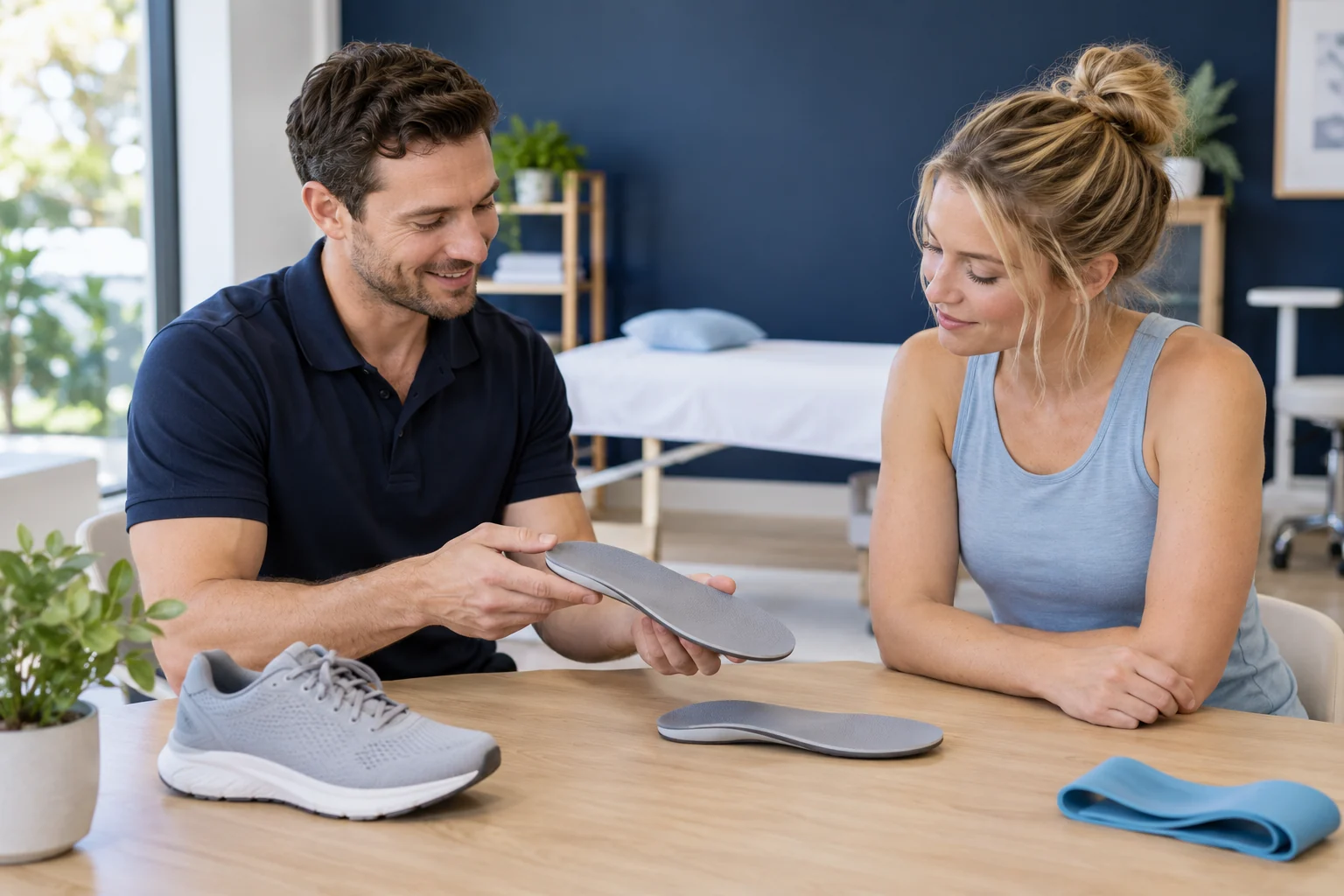
Custom-made or off-the-shelf?
Both have their place. Which suits you depends on your foot shape, your symptoms, your shoes, and what you want to get back to.
Custom-made orthotics
Made to the shape of your foot from a scan or cast, and prescribed to your assessment findings — the amount of correction, the materials, the cushioning and the shape are all specified for you.
Generally the choice where the foot shape is unusual, symptoms are long-standing, previous off-the-shelf devices haven’t worked, or the device has a specific job to do such as offloading one area.
Off-the-shelf orthotics
Pre-made devices in a range of shapes and densities, fitted and often modified by your podiatrist to suit you. Available on the day and less expensive.
Often a sensible starting point for straightforward presentations, for trying the approach before committing, and for children, whose feet are still growing and changing.
And sometimes neither. If your assessment points to stiff joints, weakness or footwear rather than a foot that needs supporting, we’ll say so and treat that instead — see foot mobilisation.
Orthotics are rarely the whole plan. They usually sit alongside footwear advice, strength and mobility work, and treatment of the painful structure itself. See foot mobilisation for the hands-on side of what we do, and tell your podiatrist if you would prefer to avoid a device — it changes what we recommend, and it is a perfectly reasonable thing to want.
What we see, and how we approach it
Assessment and treatment are always tailored to your individual presentation. The notes below are a general guide — your own plan is built after we’ve assessed you.
Heel pain and plantar fasciitis
One of the most common reasons orthotics are prescribed. The aim is to reduce the load going through the painful tissue while it settles, alongside treatment and loading work. More on heel pain.
Flat feet and arch pain
Where a low arch comes with pain, fatigue or a change in how you’re walking, an orthotic can support the foot through the parts of the step where it’s struggling. A flat foot that doesn’t hurt usually doesn’t need one.
Forefoot pain, bunions and Morton’s neuroma
Devices can be designed to take pressure off the ball of the foot or a specific painful spot, and to change how the forefoot is loaded. Useful alongside footwear changes. More on foot pain.
Knee, hip and lower back pain
Diabetic and high-risk feet
Where sensation or circulation is reduced, orthotics and footwear can help redistribute pressure away from areas at risk of breaking down. This is prescribed carefully and reviewed regularly — see diabetic foot checks.
Running and sport
For runners and field athletes, orthotics are considered alongside training load, footwear and strength — because a device alone rarely solves a problem that a training spike caused. See sports injuries.
Children’s feet
Most children don’t need orthotics. Where there is pain, or a clear mechanical driver affecting activity, they can help — usually off-the-shelf first, because growing feet change. See children’s podiatry.
What getting orthotics involves
Assessment
Your history and symptoms, a hands-on examination of how your foot and lower limb move, a look at your footwear, and watching you walk.
The recommendation
What we found, whether orthotics are warranted, which type, and what else belongs in the plan — explained before anything is ordered.
Scan or cast
For custom devices we capture the shape of your foot and send a prescription to the laboratory. Off-the-shelf devices are fitted on the day.
Fitting and review
You come back to have them fitted and checked in your shoes, with advice on breaking them in, and a review to adjust them if needed.
Custom devices take time to be manufactured, so there’s a wait between the scan and the fitting. Your podiatrist will tell you the current turnaround, the cost and what the review involves before you commit to anything.
Orthotics FAQs
Do I actually need custom orthotics?
Sometimes yes, often no. Plenty of people do well with an off-the-shelf device, better footwear, and strength and mobility work. Custom devices earn their place where the foot shape is unusual, where something specific needs offloading, or where simpler options have been tried and haven’t worked. You’ll get an honest recommendation rather than a default.
How much do they cost?
It depends on the type of device and what your plan involves, so the honest answer is that we price it after assessing you — and you’ll know the full cost before anything is ordered. Current appointment fees are on our fees page, and reception can talk you through the rest on 07 5571 7329.
Will my health fund cover them?
Many extras policies include orthotics, often under a separate annual limit from general podiatry, and some funds require the device to be prescribed by a podiatrist. Cover varies a lot between policies. Call your fund with the item details we give you, or ring reception and we’ll tell you what to ask them.
How long do they take to get used to?
Most people need a break-in period, starting with a couple of hours a day and building up. Some aching in the feet or legs early on is common as loading changes. Pain that is sharp, or that isn’t settling as you build up, is worth telling us about — adjustments are a normal part of the process.
Will I be stuck wearing them forever?
Not necessarily. For some presentations an orthotic is a long-term support; for others it’s a way of settling symptoms while strength and movement work does its job, after which reliance on the device may reduce. We’ll be clear about which situation we think you’re in, and reassess as you go.
Can I move them between shoes?
Usually between shoes of a similar type, provided the insole comes out and there’s room. Dress shoes, work boots and sports shoes often need different devices or a slimmer design — tell us which shoes you actually live in, and bring them to your appointment.
How long do they last?
That depends on the materials, your weight, your activity and how often you wear them. Top covers wear out before the device itself and can usually be replaced. We check them at review appointments and tell you when they’re past their best.
Do I need a referral?
No. Book directly any time. If your GP has given you a Medicare Chronic Condition Management Plan, bring it along — it can be used towards podiatry appointments, though not usually towards the device itself.
Hip to Toe, Arundel
138 Olsen Avenue, Arundel
Gold Coast, QLD 4214
Near the corner of Central Street, between Harbour Town and the Gold Coast University Hospital.
Phone: 07 5571 7329
Email: reception@hiptotoe.com.au
Getting here
FREE on-site parking in the car park behind the clinic, plus free street parking out the front.
Ramped entrances, a disability parking bay and an accessible bathroom. If you’d like a hand getting in, call ahead and we’ll make sure someone can meet you.
Book a biomechanical assessment
Find out what your feet are actually doing, whether orthotics would help, and what the alternatives are. No referral needed.