Bunion Treatment on the Gold Coast
Sore big toe joint, shoes that no longer fit, a bump that seems to be getting bigger? Our podiatrists assess what is driving the bunion and talk you through the options — including everything worth trying before surgery.
What to expect
- Assessment and first treatment in the same appointment
- No GP referral required
- Conservative options explained before any surgical referral
- Health fund rebates claimed on the spot
- FREE on-site parking behind the clinic
Podiatry and physio together
Both in the one clinic — and we move you across if the other one is the better fit.
No referral needed
Book straight in. Medicare care plans, DVA and NDIS patients welcome.
Health fund rebates on the spot
HICAPS in the clinic — claim as you pay and only settle the gap.
FREE on-site parking
Car park behind the clinic on Olsen Avenue, Arundel, plus free street parking.
A bunion is a joint problem, not just a bump
A bunion (hallux valgus) is a gradual change in the alignment of the big toe joint. The toe drifts towards the smaller toes and the joint at its base becomes more prominent on the inside of the foot.
The visible bump is the part people notice, but the thing that generally causes trouble is what is happening at the joint itself — how it moves, how much load it takes when you push off, and what the toes next to it are now doing.
Bunions have a strong family history, and foot shape and mechanics play a large part. Footwear does not create a bunion out of nothing, but narrow, pointed or high-heeled shoes can certainly make a developing one more painful.
How much the bunion hurts and how big it looks are only loosely related. Some prominent bunions are comfortable; some modest ones are not. Treatment follows the symptoms and the assessment, not the appearance.
Sore big toe joint? Have it assessed before it changes your shoes for you.
How the joint changes
Common bunion symptoms
At the joint
- Ache or sharp pain at the base of the big toe
- Redness, swelling or warmth over the bump
- Reduced movement, or a grating feeling, in the joint
- Pain pushing off when walking or on stairs
Elsewhere in the foot
- Hard skin or corns where the bump rubs the shoe
- Callus under the ball of the foot as load shifts across
- Crowding, rubbing or clawing of the second and third toes
- Shoes that have become uncomfortable or no longer fit
How bunions are managed
Conservative treatment does not straighten a bunion — nothing short of surgery changes the bone alignment. What it can do is reduce the pain, take pressure off the joint and the skin, and help you keep doing what you want to do. For many people that is enough.
Footwear
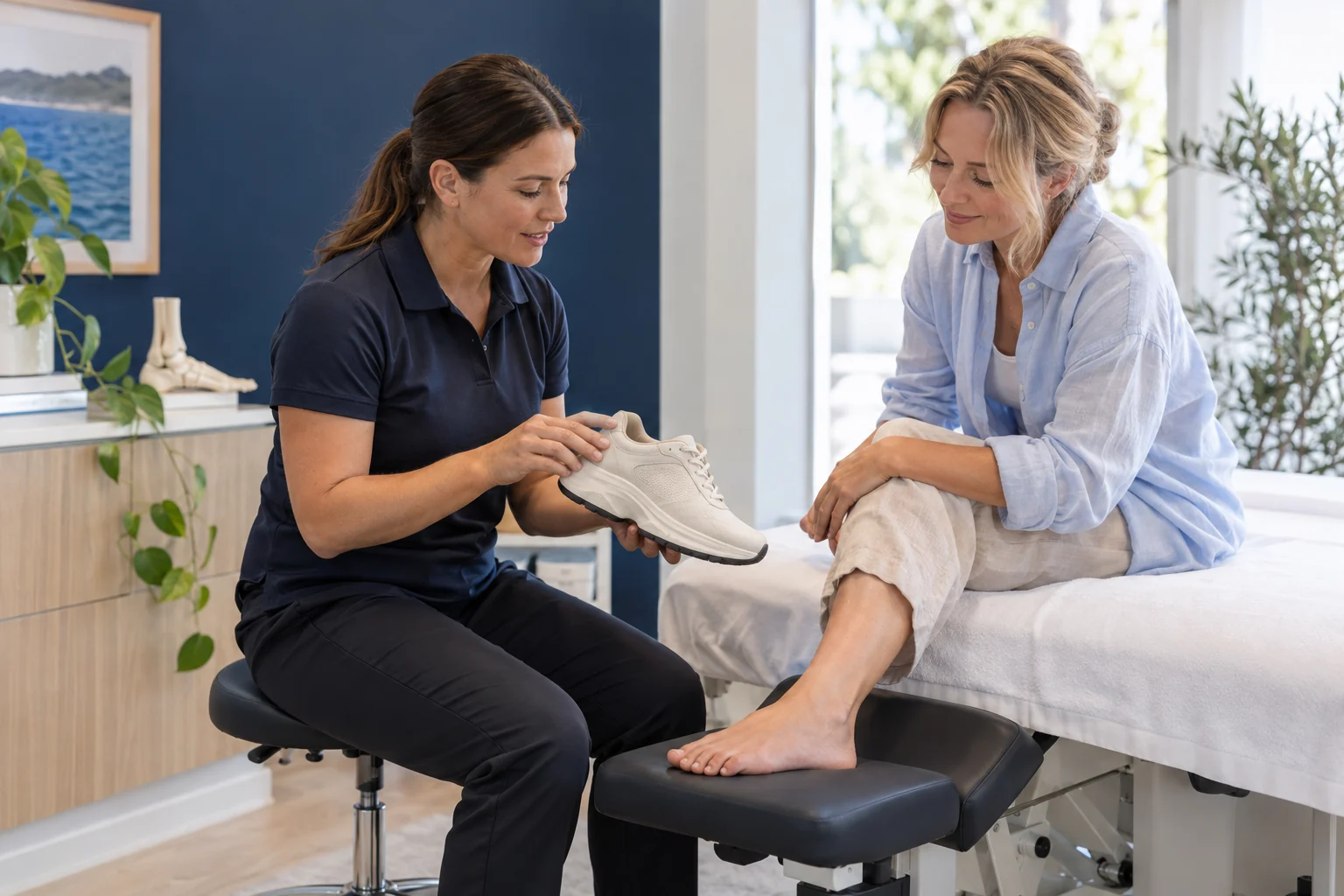
The single biggest lever for most people. A shoe with enough depth and width through the toe box, a secure fastening and a sensible heel height takes direct pressure off the joint. We will go through what to look for and, if you bring your regular shoes in, assess them with you.
Padding and offloading
Simple, cheap and immediate. Silicone or felt padding can stop the bump rubbing, and offloading the ball of the foot can settle the callus and discomfort that often comes with a bunion.
Joint mobilisation and exercise
Where the big toe joint has become stiff, restoring movement and strengthening the muscles controlling the toe may improve comfort and how the foot loads at push-off. See foot mobilisation.
Orthotic therapy where appropriate
An orthotic device can change how load is distributed across the forefoot, which for some people reduces pain at the joint. It will not reverse the deformity, and we will say so plainly. See orthotics.
Skin and nail care
Corns and callus caused by the pressure can be reduced in the clinic, which often brings immediate relief — though it will keep returning unless the pressure causing it is addressed. See corns and calluses.
Referral for a surgical opinion
Where pain persists despite conservative management, or the deformity is significantly limiting you, surgery may be the right conversation. We will refer you to an appropriate specialist and write to your GP. Bunion surgery has a meaningful recovery period, so it is worth making that decision with a clear picture of what conservative care has and has not achieved.
Book a bunion assessment — and bring the shoes you wear most.
What happens at your appointment
Your story
How long it has been there, what it stops you doing, which shoes are a problem and whether it runs in the family.
Assessment
Joint alignment and movement, the skin and the smaller toes, forefoot loading, and how you walk.
Options explained
What conservative management can realistically do for your foot, what it costs, and when a surgical opinion would be reasonable.
Treatment and plan
Padding, skin care or offloading on the day where useful, plus footwear advice and a review if needed.
Bunion FAQs
Can a bunion be fixed without surgery?
The alignment itself cannot be corrected without surgery — we would rather tell you that up front than sell you something that will not do it. What conservative treatment aims to do is manage the pain, protect the skin, slow the aggravating factors and keep you comfortable in your shoes. For a great many people that is the right trade-off, at least for a long time.
Do bunion splints and toe spacers work?
They do not straighten the joint. Some people find a spacer or a night splint comfortable and helpful for symptoms, and there is no harm in trying one. Be cautious of products advertised as correcting the deformity — the evidence does not support that claim.
Will it keep getting worse?
Bunions tend to progress slowly over years, though the rate varies a lot between people and is not easy to predict. Managing footwear and load is sensible regardless. Pain, importantly, does not always track the progression — plenty of people stay comfortable.
Do I need an x-ray?
Not for routine management. An x-ray is useful if a surgical opinion is being considered, or where the joint pain does not fit the usual pattern — for example where arthritis of the joint is the main issue rather than the alignment.
Did my shoes cause this?
Not on their own. Foot structure and family history are the larger factors. Narrow, pointed or high-heeled shoes can aggravate a developing bunion and make it more painful, which is why footwear is such a useful lever in treatment.
Do I need a referral?
No. Book directly with our podiatrists. If you have a Medicare Chronic Condition Management Plan from your GP, bring it and we can process the rebate in the clinic. DVA and NDIS patients are welcome.
Hip to Toe, Arundel
138 Olsen Avenue, Arundel
Gold Coast, QLD 4214
Near the corner of Central Street, between Harbour Town and the Gold Coast University Hospital.
Phone: 07 5571 7329
Email: reception@hiptotoe.com.au
Getting here
FREE on-site parking in the car park behind the clinic, plus free street parking out the front.
Ramped entrances, a disability parking bay and an accessible bathroom. If you’d like a hand getting in, call ahead and we’ll make sure someone can meet you.
Book your bunion assessment
An honest look at what can and cannot be done, in the one appointment. No referral needed, health fund rebates on the spot, free parking out the back.
Related: foot pain, corns and calluses, routine podiatry and orthotics.