Ingrown Toenail Treatment on the Gold Coast
Sore, red, throbbing along the edge of the nail? Our podiatrists treat ingrown toenails every week — from a simple clear-out through to minor nail surgery under local anaesthetic when it keeps coming back.
What to expect
- Assessment and treatment usually in the same appointment
- No GP referral required
- Nail surgery available under local anaesthetic
- Health fund rebates claimed on the spot
- FREE on-site parking behind the clinic
An ingrown toenail rarely fixes itself
An ingrown toenail happens when the edge of the nail grows into the skin beside it. It is most common on the big toe, though any toe can be affected. Tight shoes, cutting the nail down the sides, a nail shape that curves, sweaty feet and a knock to the toe all make it more likely.
Left alone it tends to get worse rather than better, because the nail keeps growing in the same direction. Once the skin breaks, infection becomes a real possibility.
The good news is that this is one of the most straightforward things a podiatrist does. In many cases the painful edge of nail can be removed at your first appointment and the relief is immediate.
Where the problem keeps returning, a minor procedure can treat the edge of the nail so it stops growing into the skin. Your podiatrist will talk you through whether that is appropriate for you.
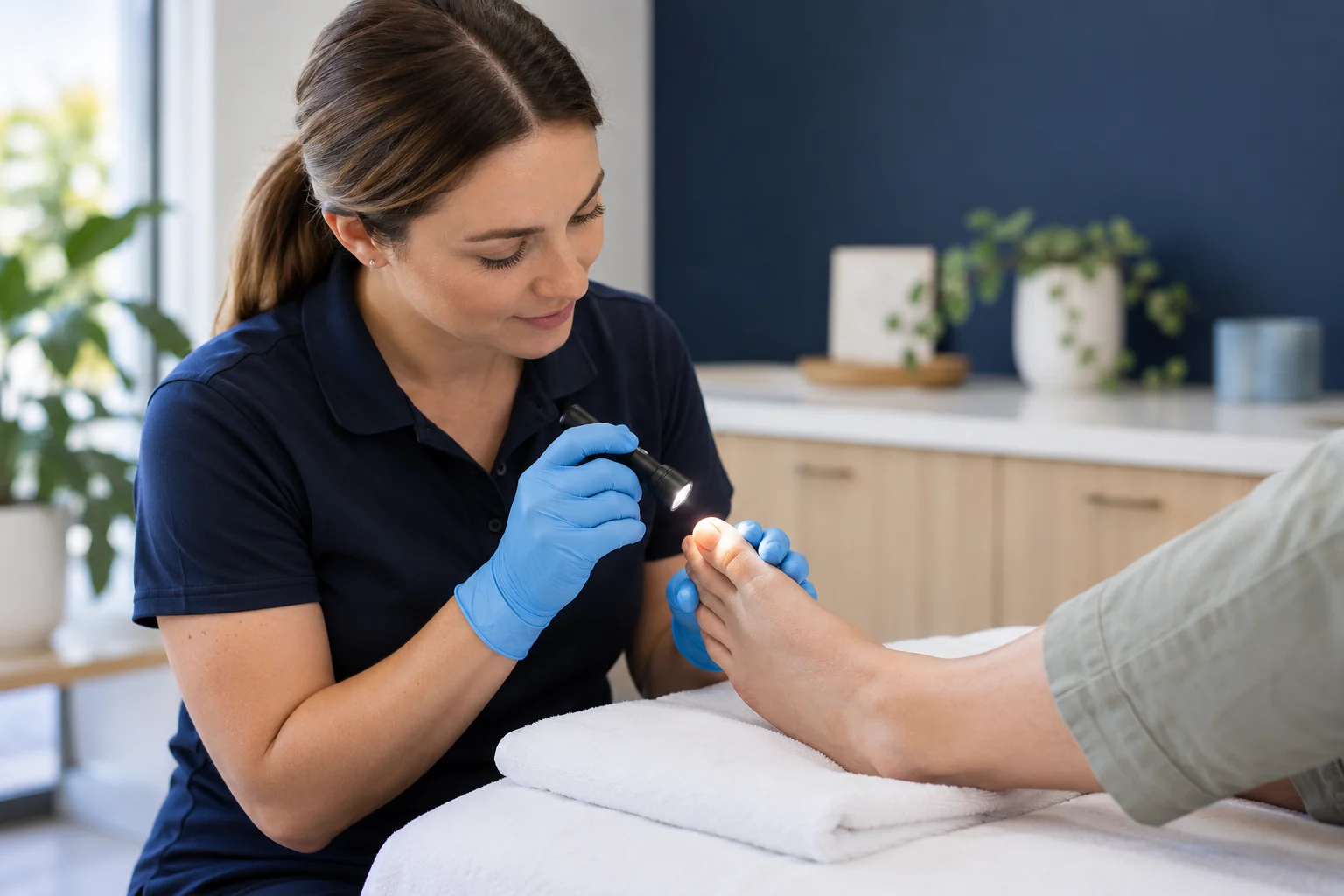
Signs of an ingrown toenail
Early signs
- Pain and tenderness along one or both sides of the nail
- Discomfort where the nail edge presses into the skin
- Pain when shoes press on the toe, or with bedsheets on it at night
- Thickened or irritated skin at the nail border
Possible infection
- Redness and warmth around the nail
- Swelling of the toe
- Discharge or pus
- Proud, raw-looking tissue at the nail edge
If infection is present your GP may prescribe antibiotics where appropriate. We work alongside your GP where that is needed.
How ingrown toenails are treated
Which option suits you depends on how severe it is, whether it has happened before, and what the nail itself is doing. Your podiatrist will assess it and explain the options before anything happens.
Conservative care
For a first episode, or where the nail is only mildly ingrown, the offending spike of nail is carefully removed and the nail edge is tidied so it can grow out properly. Most people feel considerably better straight away. You’ll also get advice on cutting technique and footwear so it is less likely to recur.
Nail surgery for recurring ingrown toenails
Where the problem keeps coming back, or the nail shape makes recurrence likely, a minor procedure can be performed under local anaesthetic. The affected portion of nail is removed, and a chemical is usually applied to the nail bed so that section does not regrow. The toe is dressed and you go home the same day with written aftercare instructions and a review appointment.
Recovery takes a few weeks of simple dressing changes. Your podiatrist will explain what the procedure involves, what it costs, what to expect afterwards and what the alternatives are, so you can decide.
If you have diabetes or circulation problems
Tell us when you book. Foot infections need closer attention where circulation or sensation is reduced, and your treatment plan and follow-up will reflect that. See our diabetic foot checks page.
What happens at your appointment
Assessment
A look at the toe, how long it has been there, whether it has happened before and whether there are signs of infection.
Options explained
What can be done today, what it involves and what it costs, plus whether surgery is worth considering if this keeps happening.
Treatment
In most cases the painful nail edge is dealt with in the same appointment, and the toe is dressed.
Aftercare
Clear instructions for home, plus a review if you have had a procedure or there are signs of infection.
Ingrown toenail FAQs
Will it hurt?
Removing a nail spike is usually quick, and the relief from the pressure is often immediate. For nail surgery, local anaesthetic is used so the toe is numb during the procedure — you’ll feel the injection itself, and your podiatrist will talk you through it. Some tenderness afterwards is normal.
Can I just dig it out myself?
We’d really rather you didn’t. Bathroom surgery usually leaves a spike of nail behind, breaks the skin, and is one of the more common ways people turn a sore toe into an infected one. It also tends to make the nail edge rougher, which encourages it to dig in again.
How long does nail surgery take to heal?
Most people are comfortable within a few days and manage normal shoes quickly, but the toe needs simple dressings for a few weeks while the skin heals. You can usually walk out of the appointment and drive home. Your podiatrist will give you an honest timeframe for your toe, and a review appointment to check on it.
Do I need a referral?
No. Book directly with us any time. If your GP has given you a Medicare Chronic Condition Management Plan, bring it along and we can process the rebate in-clinic on the day.
Can I claim on my health fund?
Yes. We process private health rebates on the spot in accordance with your provider and policy. Call reception on 07 5571 7329 with your card handy if you’d like to check what you’ll get back before you come in. Current fees are on our fees page.
Can you see my child?
Yes — ingrown toenails are common in teenagers, particularly those playing sport in tight boots. A parent or guardian stays in the room for the whole appointment. See our children’s podiatry page.
Hip to Toe, Arundel
138 Olsen Avenue, Arundel
Gold Coast, QLD 4214
Near the corner of Central Street, between Harbour Town and the Gold Coast University Hospital.
Phone: 07 5571 7329
Email: reception@hiptotoe.com.au
Getting here
FREE on-site parking in the car park behind the clinic, plus free street parking out the front.
Ramped entrances, a disability parking bay and an accessible bathroom. If you’d like a hand getting in, call ahead and we’ll make sure someone can meet you.
Get that toe sorted
Assessment and treatment usually in the same appointment, no referral needed, and free parking out the back.
More on what else our podiatrists treat: routine podiatry, fungal nails and corns, calluses and warts.